



Looking for Document or Record Storage Near Bethlehem, PA?
Boxes of records look sturdy until one tears open at the bottom and 10 years of paperwork hits the floor.
Paper is heavy. It also reacts to moisture, heat, cold, pests, poor packing, and time. A short stack of current files is one thing. Archived business records, family documents, photographs, or files that may sit for years need more thought.
Here’s the important part for anyone researching record storage in Bethlehem, PA - StorHouse-Nazareth Pike has commercial storage and drive-up units, but it does not have interior access or climate control.
That makes the Bethlehem facility a straightforward option for qualifying business supplies, office furniture, and other sturdy items. It isn’t the location StorHouse should recommend for sensitive paper records.
For documents that need a more consistent indoor environment, the nearby Allentown facility is the better place to start.
Why the Storage Environment Matters for Paper
Paper doesn’t need much encouragement to become damaged.
Humidity can cause pages to curl, stick, or develop odors. Large temperature changes may affect paper, photographs, adhesives, and some types of ink. Cardboard boxes can also weaken when they’re exposed to moisture.
A search for document storage near me may bring up plenty of nearby units, but distance shouldn’t be the only deciding factor. The storage environment matters more when records are irreplaceable, legally important, or expected to remain boxed for a long time.
StorHouse’s Document Storage page explains the broader considerations for household and business files.
Climate control doesn’t guarantee that documents will stay in their original condition. Packing, handling, water exposure, pests, and the condition of the records before storage still matter. It simply provides a more consistent environment than a standard unit.
Consider the Allentown Location for Sensitive Records
StorHouse Self Storage – Lehigh Street at 1449 Lehigh Street in Allentown has climate control and interior access. It also offers elevator access, 24-hour cameras, ADA accessibility, and on-site management.
Those features make Allentown a more appropriate StorHouse option for customers near Bethlehem who need to store paper files, photographs, or other sensitive records.
The trip may be slightly longer, but that’s usually a better trade than putting important documents into a unit that doesn’t match their storage needs.
Customers can also review StorHouse’s Climate-Controlled Units information before choosing a location. Ask the Allentown staff about current unit availability and the route from the unloading area to the available space.
Decide What Actually Needs to Be Stored
Don’t pay to store paperwork that should have been shredded three years ago.
Sort records before boxing them. Separate active files from long-term archives and remove duplicate copies when your record-retention policy allows it. Households can do the same with old statements, warranties, school papers, and personal files.
Businesses should follow the legal, tax, privacy, insurance, and industry requirements that apply to their records. Retention periods aren’t universal, and a self-storage company shouldn’t decide which documents your business must keep.
When you’re unsure, ask the appropriate accountant, attorney, records manager, or industry professional before destroying anything.
Create clear categories for the records that remain:
- Active files that may need to be retrieved
- Archived records with a known review date
- Permanent or irreplaceable documents
- Files approved for future destruction
A review date keeps the unit from turning into a permanent home for boxes nobody remembers.
Use Boxes That Can Handle the Weight
Paper becomes heavy fast. A large box may be easy to fill and miserable to lift.
Use smaller, sturdy record boxes that can support stacking. Don’t reuse boxes that are soft, torn, or already crushed at the corners. Keep every document dry before packing.
Label boxes with enough detail to find the contents without opening them. Avoid writing private or sensitive information on the outside. A box number and broad category may be enough if the full description stays in a separate inventory.
For example, “Box 24, Accounts, 2024” is more useful than “Old Files.” The inventory can hold the detailed contents and authorized destruction date.
Don’t overbuild the stacks. Heavy boxes placed too high can become unstable, and the lower boxes may buckle under the weight.
Create an Inventory Outside the Unit
A storage unit full of documents is only useful if someone can find the right file.
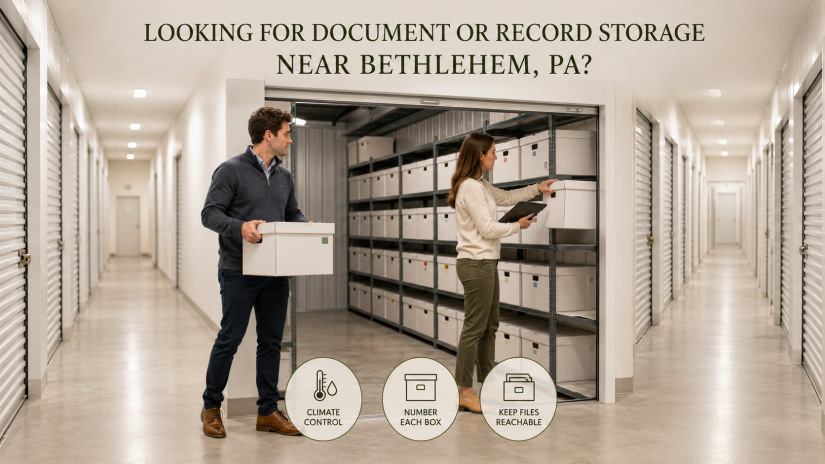
Number every box and create a searchable inventory. Note the category, date range, department or owner, storage location, and review date. Keep that inventory outside the unit.
Businesses should decide who is allowed to access the records and who manages the storage account. If several employees may retrieve files, create a simple sign-out process so documents don’t disappear without explanation.
Keep account credentials, access information, and payment responsibility with the appropriate person. An employee leaving the company shouldn’t take the only copy of the storage inventory with them.
Take photos of the labeled boxes and the finished layout. A quick image can help someone find the correct stack before driving to the facility.
Keep Frequently Used Records Reachable
Not every archived box should be packed the same way.
Records with an upcoming review, audit, or destruction date should stay near the front. Permanent files that rarely move can sit farther back. Keep a narrow aisle if the unit holds more than a few rows of boxes.
Place labels where they can be read from the aisle. Shelving may make retrieval easier, but it needs to be stable and suitable for the weight of paper. Don’t improvise with weak furniture or damaged shelving.
Store documents separately from liquids, cleaning supplies, food, or anything that could leak or create an odor. Ask the facility about prohibited items before move-in.
Use Bethlehem for the Items That Fit It
The honest recommendation isn’t that every business item must go to Allentown.
StorHouse-Nazareth Pike has Commercial Storage and drive-up access. It may suit qualifying office furniture, boxed supplies, equipment, displays, or other sturdy business property that doesn’t require climate control or interior access.
That gives Bethlehem businesses a practical way to split the load. Sensitive records can go to the climate-controlled Allentown facility, while general business items can be discussed with the Bethlehem team.
Don’t choose a unit based on the commercial-storage label alone. Tell StorHouse exactly what you plan to store. The material matters.
Talk With the Allentown Team Before Moving Records
StorHouse is family-owned and operated directly by RAB Management Corp. Customers work with StorHouse staff rather than an unrelated third-party management company.
For sensitive document or record storage near Bethlehem, contact StorHouse Self Storage – Lehigh Street in Allentown. Explain what kinds of records you have, how many boxes need space, how often they’ll be accessed, and how long they may remain stored.
The staff can explain current unit availability, interior access, climate-controlled options, and the move-in route. That conversation should happen before the records are loaded into a vehicle, not after.


